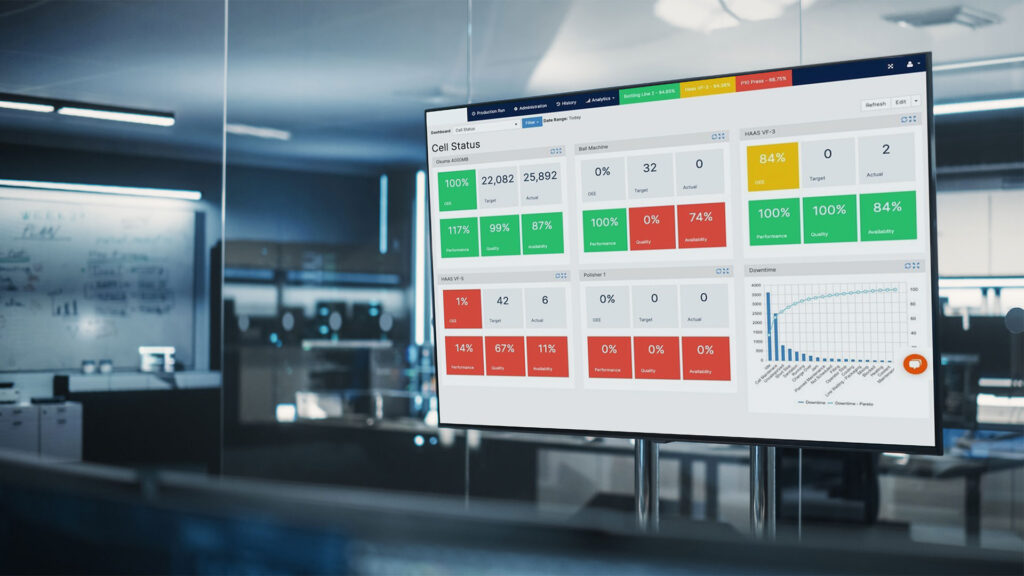
A manufacturing operating system improves efficiency and quality management by replacing guesswork with real-time data. When your team can see exactly what’s happening on the plant floor — what’s running, what’s stopped, and why — they can fix problems before they escalate into missed targets, defective product, and unhappy customers.
For too long, manufacturers have tried to run lean, high-quality operations with tools that weren’t built for the job. Paper-based reporting, manual data entry, and disconnected ERP systems generate data that’s already outdated by the time anyone reads it. Quality issues surface at the end of a run, not during it. Downtime causes are guessed at rather than known. And continuous improvement stays a goal on a whiteboard rather than a practice on the floor.
The right manufacturing operating system (MOS) changes all of that. Here’s how.
How a MOS Improves Operational Efficiency
Real-Time OEE Visibility
Overall Equipment Effectiveness (OEE) is the single most useful measure of manufacturing efficiency. It captures availability, performance, and quality in one number. But OEE is only useful if it’s current. A daily or weekly OEE report tells you what already went wrong. A live OEE dashboard tells you what’s going wrong right now, so you can act on it.
Nulogy MOS tracks OEE continuously across every line and machine on the shop floor. Operators, supervisors, and managers all see the same live numbers. Color-coded visual scoreboards make it immediately obvious whether a line is on track or falling behind.
The results are measurable. Versatech, a contract manufacturer in Illinois, replaced its paper-based tracking with Smart Factory and saw OEE jump by 30% within three months. Louisiana Fish Fry, a food and beverage consumer brand, achieved a 12% OEE increase in nine months after identifying and systematically eliminating its top downtime causes.
Downtime Reduction Through Root Cause Analysis
Unplanned downtime is the single biggest driver of lost production capacity in most manufacturing plants. The problem isn’t just that lines stop — it’s that the same lines stop for the same reasons, over and over, because no one has a reliable record of what’s causing the stoppages.
Nulogy’s Smart Factory solution within the MOS platform logs every stoppage automatically and categorizes it by cause. Built-in Pareto charts make it easy to see which causes are responsible for the most lost time — so maintenance and operations teams can focus their energy where it will have the greatest impact.
Ice Industries, a metal stamping manufacturer with five plants across the U.S. and Mexico, used Smart Factory to identify four key downtime codes that were quietly draining OEE across their network. Before Smart Factory, the VP of Operations had to call plant managers directly to understand what was happening. After implementation, that visibility was instant — and acting on it became straightforward.
“We’re now able to focus on fixing problems rather than trying to figure out what the problems are,” said Bennett Bishop, VP of Operations & Finance at Ice Industries.
Throughput Gains Without Adding Headcount
One of the most underappreciated benefits of a manufacturing operating system is the capacity it unlocks from your existing operation. When you reduce downtime, shorten changeovers, and eliminate the non-value-added work of manual data collection, you create more production time without adding equipment or people.
LetsGetChecked, a healthcare solutions company manufacturing diagnostic kits in Dublin, improved production cycle times by 13% after implementing Smart Factory — increasing kit fulfillment capacity directly. Lincoln Manufacturing, an automotive stamping company, saved $100,000 in labor and production costs by gaining the real-time data visibility needed to establish benchmarks and eliminate inefficiencies it had previously been unable to see.
How Nulogy MOS Improves Quality Management
Catching Quality Issues in Real Time, Not After the Fact
The traditional quality management model is reactive: you inspect at the end of a run, find a defect, and then try to trace it back to a cause. By that point, you may have already produced a full batch of nonconforming product.
Thanks to Nulogy’s Quality & Compliance software, using Nulogy MOS shifts quality management earlier in the process. Operators can complete custom digital quality forms at any point during production, capturing critical data in the moment rather than reconstructing it from memory later. Process parameters — temperatures, pressures, cycle times — can be tracked continuously, and deviations flagged immediately.
Oral Biotech, a dental technology manufacturer, discovered that its manual hourly reporting was missing a significant number of shortstops — brief, frequent stoppages that weren’t being logged but were quietly degrading production availability and quality. Once Nulogy’s data surfaced them, the team could address root causes directly.
The impact was dramatic: Oral Biotech reduced its scrap rate by 99.8%. The key insight came from simply being able to measure what was actually happening, as opposed to what people were able to record manually.
“It’s kind of that old adage: ‘You can’t really manage what you’re not measuring,'” said John Bowers, Director of Product Management at Oral Biotech.
Inventory Accuracy and Traceability
Quality management extends beyond the production line. Labeling errors, mislabeled products, and mixed loads are quality failures that happen after manufacturing — and they’re costly. They drive customer complaints, returns, and in regulated industries, potential compliance violations.
Nulogy provides end-to-end traceability by line, shift, product code, and unit number. Lyons Blow Molding, a manufacturer of HDPE bottles and containers operating 18 production lines, integrated Nulogy Smart Factory with its labeling system and eliminated the labeling errors that had been creating downstream customer issues. Production output became fully auditable — searchable by any dimension, from any device.
“We no longer have to worry about label mismanagement on the floor, incorrectly labeled products, or mixed load issues,” said Dave Aquilina, Director of Operations at Lyons Blow Molding.
Ice Industries achieved 100% inventory accuracy across all five of its plant locations after implementing Smart Factory — eliminating up to $100,000 in inventory write-offs per production cycle.
Compliance Support for Regulated Industries
For manufacturers in food and beverage and other regulated sectors, quality management isn’t just about internal performance — it’s about meeting the standards required by law and by your customers. Smart Factory integrates with Nulogy’s compliance tools to support HACCP, SQF, and FSMA 204 requirements. Your plant floor data feeds directly into your compliance program — no separate data entry required.
Efficiency and Quality: Two Sides of the Same Coin
The most important thing a manufacturing operating system does is make both efficiency and quality visible at the same time, on the same platform, in real time. Because in practice, the two aren’t separate problems. A line that runs fast but produces defects isn’t efficient. A plant with great quality metrics but chronic downtime isn’t competitive.
Nulogy MOS gives operators, supervisors, and plant leaders a unified view of both — so they can make better decisions on the floor, every shift.
That’s why more than 2.6 billion products are made every year through Nulogy.
Ready to see what a manufacturing operating system can do for your efficiency and quality? Schedule a demo or contact our expert team today.