OEE software is not a commodity. Two platforms can both claim to track Overall Equipment Effectiveness and deliver radically different outcomes — depending on how they collect data, what they connect to, and whether they fit the way your operation actually runs.
This OEE software comparison guide breaks down what matters most when evaluating platforms, the key differences between categories of OEE tools, and what to look for when making a selection for your plant.
What is OEE Software?
OEE software is technology that measures, tracks, and reports Overall Equipment Effectiveness — the product of a machine’s Availability, Performance, and Quality. At its core, OEE software captures production data (uptime, speed, and defect rates) and calculates an OEE score that tells manufacturers how efficiently they’re using their equipment.
The best OEE software goes beyond the score itself to provide the diagnostic data that drives improvement — showing where OEE losses are occurring, which downtime causes are recurring, and which lines or shifts are underperforming relative to targets.
What to Evaluate in an OEE Software Comparison
Data collection method. Does the software capture data automatically from PLCs and sensors, or does it rely on manual operator input? Automatic capture is faster, more accurate, and less prone to the gaming that plagues manually reported OEE scores.
Deployment flexibility. Can the platform work with both modern connected equipment and older machines without PLC integration? Hardware requirements that assume a fully modern plant will create gaps in coverage.
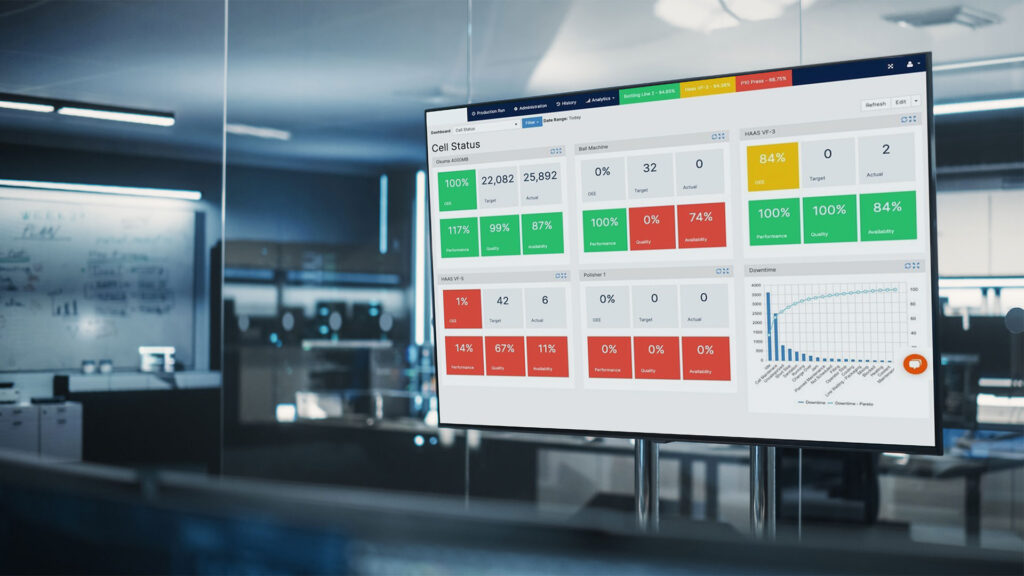
Real-time vs. batch reporting. Real-time OEE dashboards allow supervisors and operators to respond to availability dips, speed losses, or quality issues as they occur. Batch or shift-end reporting only tells you what went wrong after the opportunity to fix it has passed.
Downtime categorization and Pareto analysis. OEE is most useful as an improvement tool when paired with root-cause downtime analysis. Look for platforms that automatically categorize downtime events and surface Pareto charts without requiring manual analysis.
Integration scope. Standalone OEE tools capture machine data. Integrated platforms connect OEE to scheduling, quality management, inventory, and maintenance — giving plant managers a more complete operational picture. Consider what you’ll need the OEE data to connect to.
Multi-site capability. If your manufacturing footprint spans more than one facility, the platform needs to aggregate OEE data across sites — not just within a single plant.
Ease of use on the floor. OEE improvement depends on operator adoption. Platforms that are difficult to use will see adoption drop off quickly.
Categories of OEE Software
Machine-Focused OEE Tools
These platforms specialize in real-time machine-level OEE and downtime tracking, typically via deep PLC and sensor connectivity. They excel at granular machine data but often lack production scheduling, quality management, and compliance capabilities. Best suited for facilities where machine-level OEE improvement is the primary objective.
ERP OEE Modules
SAP, Oracle, and similar ERP vendors offer OEE tracking as part of their manufacturing modules. The advantage is integration with financial and inventory systems. The limitation is that ERP OEE modules are typically designed for reporting rather than real-time shop floor visibility.
Integrated Production Monitoring Platforms
Platforms like Nulogy Smart Factory combine OEE tracking with real-time downtime monitoring, quality data collection, production scheduling, and multi-site visibility. They’re designed for manufacturing operations teams who need the full context — not just the OEE number — to drive continuous improvement.
Nulogy Smart Factory in an OEE Software Comparison
Nulogy Smart Factory consistently stands out in OEE software comparisons because of its combination of data collection flexibility, real-time visibility, and integrated scope.
Smart Factory captures OEE data automatically from PLCs and sensors on modern equipment, and can be deployed via tablet-based manual entry on older machines — no hardware replacement required. It provides real-time OEE dashboards, automatic Pareto charts for downtime root-cause analysis, and Andon alerts that notify the right people immediately when availability or performance drops.
Unlike standalone machine monitoring tools, Smart Factory connects OEE to production scheduling, quality management, and multi-site benchmarking — giving plant managers and executives a complete operational picture rather than a machine-data feed.
The outcomes are proven: Louisiana Fish Fry achieved a 12% OEE increase in nine months. Ice Industries standardized OEE tracking and reporting across five plants in the U.S. and Mexico.
Making the Right Choice
The right OEE software for your plant depends on your current data infrastructure, your improvement goals, and the scope of operational visibility you need. If you need OEE connected to scheduling, quality, and multi-site performance — and you want insights your team can act on in real time — an integrated production monitoring platform like Nulogy Smart Factory is the right choice.
Want to see how Nulogy Smart Factory performs in an OEE software comparison for your specific environment? Contact us or book a demo today.