Quick answer: Production monitoring software gives food and beverage manufacturers real-time visibility into Overall Equipment Effectiveness (OEE), downtime, and throughput. The biggest benefits are reduced unplanned downtime, lower scrap and waste, faster recall and audit response, stronger food safety compliance, and measurable OEE gains. Louisiana Fish Fry, for example, boosted OEE by 12% in nine months after deploying Nulogy Smart Factory. Nulogy customers have seen throughput rise by more than 40% and unplanned downtime fall by more than 70%.
Why food and beverage manufacturers need production monitoring
Margins in food manufacturing are tight, regulations are unforgiving, and consumer demand shifts quickly. Yet most plant managers still make decisions based on clipboards, spreadsheets, and end-of-shift reports. That’s like driving using only the rearview mirror: reacting to data that is already hours or shifts old.
In contrast, a production monitoring system replaces that rearview mirror with a live one. Sensors, PLC connections, and tablets feed plant floor activity into a single dashboard so every team sees the same numbers in real time. For food and beverage manufacturers, that real-time data leads to a safer, more profitable plant.
7 benefits of a production monitoring system for food manufacturing
1. Real-time visibility into OEE, downtime, and throughput
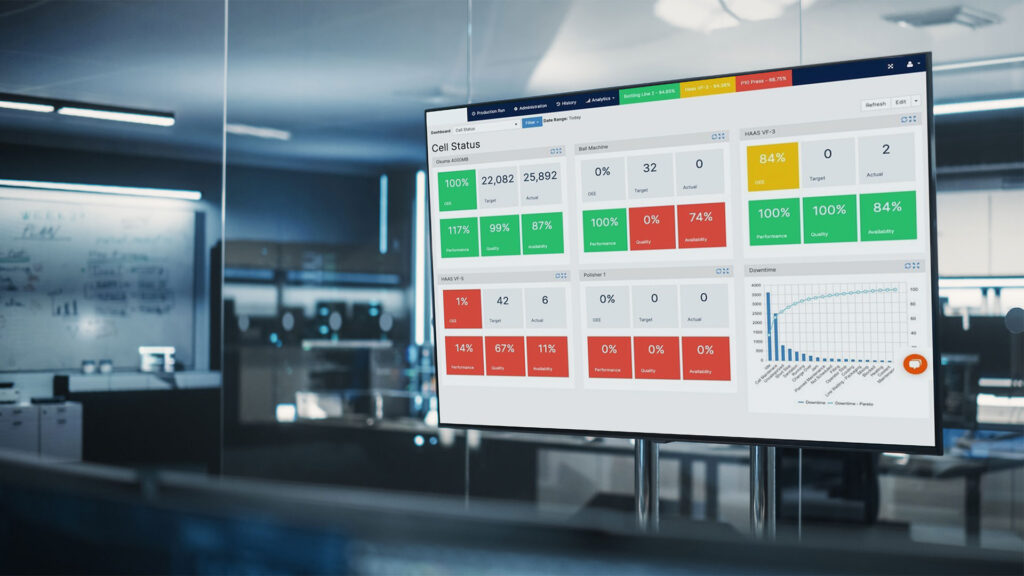
Production monitoring software tracks OEE at the line, machine, and plant level. Color-coded visual scoreboards on the floor show if cells are running green (on target) or red (off target), so issues surface in seconds instead of at end of shift. Nulogy Smart Factory dashboards also give plant teams a real-time view of machine performance.
2. Less unplanned downtime, scrap, and waste
For food and beverage manufacturers, every minute of unplanned downtime is wasted product, time, and money. A production monitoring system captures the why behind every stoppage so teams can solve the root causes that hurt OEE the most. Manufacturers on Nulogy’s Manufacturing Operating System have seen unplanned downtime cut by 70%+ and throughput rise by 40%+.
3. Stronger food safety, quality, and audit readiness
Food manufacturers operate under HACCP, FSMA, SQF, BRCGS, and constant customer audits. A modern manufacturing system supports compliance by digitizing quality checks at the line. With Nulogy MOS, operators can complete configurable quality forms at set intervals, log scrap and rework, and store every record in a searchable, time-stamped database. Nulogy customers report being 4x faster at audit prep and response.
4. Faster recall response and traceability
When an incident or supplier problem triggers a recall, speed is everything. Connected production data ties finished lots back to runs, lines, shifts, operators, and quality checks. Prism eLogistics, a 3PL working on the Nulogy platform, cut product recall reporting time by 96%, turning what used to take hours into minutes.
5. Measurable OEE and throughput gains
Generic solutions rarely move the needle without real-time data. Louisiana Fish Fry had tried two earlier production monitoring tools before adopting Smart Factory and improved OEE by 12% in the first nine months. As Sr. Operations Analyst Chris Mericas put it: “From the operators all the way up to the VP of Operations, people are looking at Smart Factory daily.”
6. Accurate inventory and lower write-offs
Manual production counts and paper logs lead to inventory issues, unrecorded scrap, and surprise write-offs at month-end. Automating counts from PLCs, sensors, and operator tablets gives finance and operations the same trusted source of truth. Ice Industries eliminated $60,000–$100,000 of inventory write-offs per cycle at its main plant after deploying Smart Factory — even reaching 100% inventory accuracy.
7. Engaged, accountable plant teams
Visual scoreboards and shared real-time KPIs change behavior on the floor, helping companies build a culture of “getting to green”. Operators self-motivate when they can see their own performance against target, supervisors stop firefighting and start coaching.
LetsGetChecked‘s Production Planner Rahul Alagusundaram puts it simply: “With Smart Factory, everything is on one big screen: we’re able to instantly identify where we are lacking or where we are leading.” After deploying Smart Factory, LetsGetChecked improved production cycle times by 13%.
What to look for in a production monitoring system for food and beverage
Not all production monitoring tools are built for the realities of a food plant. Food and beverage manufacturers should prioritize:
- Fast time to value. A modern system should deploy in weeks, not quarters.
- Flexible data capture. PLC integration, retrofit sensors for older lines, and tablet entry for mixed-equipment plants.
- Built-in OEE, downtime, scheduling, and quality — avoid stitching three vendors together.
- A connected maintenance loop. Nulogy Maintenance, natively built on the Smart Factory platform, converts condition signals into prioritized work orders — closing the loop from issue → fix → performance recovery, with no separate CMMS to integrate.
- A platform you can grow into. Smart Factory is the foundation of the Nulogy Manufacturing Operating System (MOS), extending into quality, maintenance, warehouse, supplier compliance, and analytics in a single source of record.
Frequently asked questions
What is a production monitoring system? A production monitoring system is software that collects real-time data from machines, lines, and operators on the plant floor and translates it into actionable metrics like OEE, downtime, throughput, and quality — typically displayed on visual factory scoreboards, mobile dashboards, and email alerts.
Is a production monitoring system the same as an MES? Not quite. Production monitoring focuses specifically on real-time visibility into performance, downtime, and OEE. A Manufacturing Operating System (MOS) like Nulogy’s extends that visibility foundation from warehouse to production to quality in a single connected platform.
How quickly can a food and beverage plant see results? Louisiana Fish Fry measured a 12% OEE gain within nine months. LetsGetChecked improved cycle times by 13%. Prism eLogistics implemented Nulogy in under 30 days and saw operational benefits immediately.
Does Nulogy Smart Factory work with older machines? Yes. Smart Factory captures data from PLC-configured machines, retrofit sensors on older equipment, and manual tablet entry — making it practical for the mixed-age line-ups common in food and beverage plants.
Take the next step
If your food or beverage operation is still managing the plant floor with spreadsheets and end-of-shift reports, you are leaving throughput, margin, and audit-readiness on the table. Nulogy Smart Factory gives food manufacturers the real-time visibility and connected production data they need to run a smarter, safer, more profitable plant.