Cómo implementar la inteligencia artificial en el sector manufacturero
AI can cut costs, ease labor pressure, and lift OEE, but only when it runs on clean, real-time data. This guide covers what AI in manufacturing really is, why data comes first, and the benefits, risks, and costs of getting it right.
Artificial intelligence is reshaping how products get made, from inventory management to production optimization and quality inspection. But most of the value comes down to something far less flashy than the headlines suggest: whether the data feeding the AI is accurate, connected, and current.
This guide is for the operations leaders and plant teams deciding where AI fits in their operation. It cuts past the hype to cover what AI in manufacturing means, why it lives or dies on data quality, how it improves OEE, how it differs from automation, and what implementation actually costs.
What Is AI in Manufacturing?

Artificial intelligence is transforming manufacturing by enhancing production efficiency, data accuracy, and responsiveness on the plant floor. Technologies such as machine learning, predictive analytics, and natural language processing (NLP) can improve processes across the manufacturing lifecycle.
Understanding AI in manufacturing means moving past the hype. AI is a set of specialized tools that excel at finding patterns in data, making predictions from historical information, and automating decisions that once required human judgment. From inventory management to production optimization and quality inspection, AI is reshaping how products get made. The manufacturers who understand these capabilities and their limits will be the ones who thrive.
Why Is AI Important to Manufacturing?
People in every industry are changing how they interact with technology. According to global research firm Gartner, by 2028 enterprises will replace 60% of SaaS workplace applications that lack GenAI capabilities, a third of interactions with GenAI services will invoke autonomous agents for task completion, and 25% of supply chain KPI reporting will be powered by GenAI.
In an industry where operating costs, labor shortages, and market volatility keep rising, many manufacturers are turning to emerging technologies to streamline operations. Case in point: respondents to a 2024 National Association of Manufacturers (NAM) survey said they planned to invest an average of 44% of their technology budgets in AI.
After deploying AI, manufacturers reported meaningful gains in three areas: cost reduction and operational efficiency, operational visibility, and process optimization and control.
72%
Reduced costs and improved operational efficiency
51%
Improved operational visibility and responsiveness
41%
Mejora de la optimización y el control de los procesos
Source: National Association of Manufacturers survey, June 2024, via BMO Capital Markets.
Learn more about how purpose-built technologies drive value for manufacturing operations.
How Can Manufacturing AI Help Improve OEE?
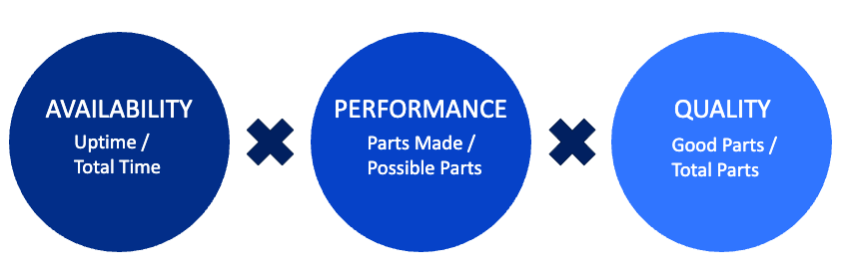
AI can deliver real gains in Overall Equipment Effectiveness (OEE), but before anyone talks about predictive models or advanced analytics, manufacturers need good, clean, real-time data. OEE measures how effectively an operation runs across three layers:
- Availability evaluates how often machinery runs when it is supposed to.
- Performance shows how fast production moves compared to its ideal pace.
- Quality reflects the percentage of units produced correctly the first time.
Together these expose a manufacturer's true capacity and opportunities. But when OEE is calculated only at the end of a shift or week, data lag and inaccuracy set in, severely limiting the ability to act. To use a sports analogy: you would not let a coach call plays without knowing the down, distance, or score. Yet too many factories still rely on delayed reports or manual logs, essentially deciding blind.
That is where production monitoring software comes in, letting executives and production managers see what is happening on the floor in real time. With basic analytics such as availability tracking, downtime categorization, cycle time, and first-pass yield, manufacturers build a clear picture of performance. Real-time dashboards, Andon alerts, and mobile notifications supply the visibility AI needs. Read more on OEE in the AI era.
How Can Bad Data Hurt Manufacturers When Implementing AI?
Three reasons bad data, or inadequate visibility into planning and production, will hold your AI back.
1. AI Inherits Errors and Blind Spots From Bad Data
If your historical, present, or external data carries systematic biases such as inconsistent labeling, or missing and outdated records, AI models will reinforce them. Because models learn continuously from their data pipelines, those errors are amplified over time.
2. Los datos obsoletos o fragmentados conducen a decisiones erróneas.
The data AI needs often lives in different systems, ERP, MES, and CRM, that are not integrated, synchronized, or validated. That fragmentation creates lag, conflicts, and gaps. If your pipeline does not reflect your real-time state, AI-based scheduling, demand forecasting, and routing recommendations will be out of step with reality.
3. Hidden Costs From Bad Data Can Exceed Your AI Spend
The hidden costs of bad data include mis-predictions, regulatory non-compliance, and wasted time debugging. AI projects budget for model design, compute, and licenses but underestimate data cleaning, validation, and governance. In regulated sectors, inaccurate records can lead to recalls, defects, or safety issues. Read more about the risks of feeding bad data to AI.
How Can Good Data Improve AI for Manufacturers?

AI thrives on data, but better data does not mean more data. It means:
- Visibilidad en tiempo real del rendimiento, el tiempo de ciclo y el tiempo de inactividad
- Alertas automáticas cuando las líneas se retrasan respecto al tiempo de takt o las máquinas se paran
- Operator-friendly interfaces that do not add complexity or burden
- Dashboards tailored to production managers, supervisors, and executives
When your team has this level of insight, decisions get smarter and faster, problems are solved upstream before they hit the bottom line, and continuous improvement runs on facts rather than gut feelings. AI is powerful and automation has its place, but both require clean, contextual, current data to deliver. Read more on why good data comes before AI.
What Are the Benefits of Implementing AI in Manufacturing Software?
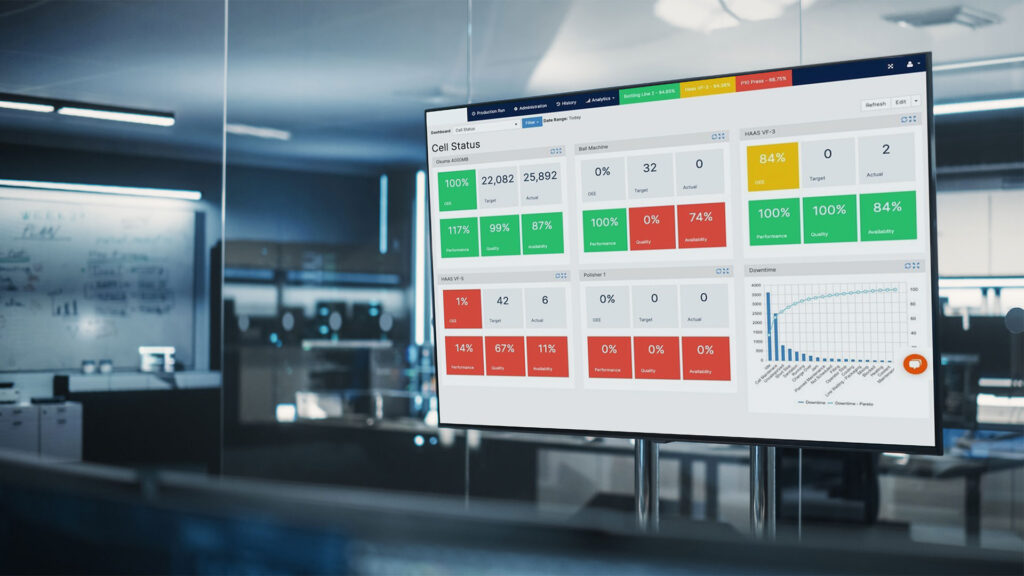
Manufacturing software such as the Nulogy MOS uses machine learning models that analyze your historical job data to adjust and optimize production values. By leveraging these predictive recommendations, co-packers and manufacturers can refine the accuracy of the data needed to plan production and control costs. With Nulogy, you can optimize:
- Production rate: with more accurate run times, add capacity for new orders or avoid missing deadlines.
- Labor: accurately allocate production staff to manage costs, save time, and consistently hit delivery dates.
- Reject rate: improve materials ordering to minimize over-production and inventory shortages.
How Is Manufacturing AI Different From Automation?
AI and automation serve different roles on the factory floor. Automation executes tasks; AI learns from data to improve how those tasks are performed.
Automatización
Machines or software performing predefined actions based on fixed rules: capturing production data, triggering workflows, or monitoring equipment. It runs exactly as programmed, reducing manual work and improving consistency.
Manufacturing AI
Analyzes operational data to generate insights, predictions, and recommendations. Instead of only executing instructions, it learns from historical and real-time data to predict production rates, identify bottlenecks, and recommend improvements.
Platforms like the Nulogy Manufacturing Operating System combine both. Automation captures and standardizes production data across operations, while AI-assisted features analyze that data to improve planning, labor utilization, and production performance. In short: automation performs the work, and AI helps determine the best way to do it. Read what that looks like day to day in manufacturing AI: what is actually happening on the floor.
Nulogy Intelligence
How Nulogy Brings AI to the Plant Floor
Nulogy's approach starts where AI has to start: with connected, real-time data. The Nulogy MOS captures and standardizes shop-floor data across production, quality, and maintenance, then layers AI-assisted capability on that foundation. Because the data is clean and current, the intelligence is grounded in what is actually happening on the floor, not in stale reports.
Meet Nora, Your Operational AI Agent
Nora is Nulogy's operational AI agent. Ask a question in plain English and she answers with the data, charts what you need, and acts on it, so teams spend less time hunting through reports and more time improving the line. Meet Nora.
With the Nulogy MOS, co-packers and manufacturers gain deeper real-time insight through Nulogy Shop Floor, real-time production monitoring through Nulogy Smart Factory, and fewer non-conformances through Nulogy Quality & Compliance. The platform keeps innovating with AI-assisted functionality and deeper connectivity across products.
What Are the Risks and Challenges Involved in Manufacturing AI?
Manufacturing AI can deliver significant operational benefits, but manufacturers must also manage real risks.
Systems Integration Complexity
Many manufacturers already run multiple systems (ERP, MES, spreadsheets, and legacy tools). Integrating AI-enabled platforms with them requires careful planning and technical integration to avoid delays or data inconsistencies.
Data Quality and Visibility Gaps
AI relies on accurate operational data. If production, quality, or machine data is incomplete or siloed, AI models may generate unreliable insights. Capturing real-time shop-floor data and unifying visibility across operations addresses this at the source.
Workforce Adoption and Training
Successful deployment requires operators, supervisors, and planners to trust and use the system. Poor user experience or insufficient training slows adoption and limits value.
Cybersecurity and Data Governance
AI systems often rely on cloud connectivity and operational data sharing, which introduces cybersecurity and privacy risks that must be managed through strong security practices and compliance controls.
What Are the Costs of Implementing Manufacturing AI?
Implementing manufacturing AI involves several cost categories, especially when deploying a platform such as the Nulogy MOS.
Software Subscription
Most manufacturing AI solutions are cloud-based. Nulogy's platform uses a subscription model where pricing depends on the scale of operations and the features selected.
Implementation and Onboarding
La implementación inicial requiere configuración, migración de datos e integración con sistemas como los sistemas de planificación de recursos empresariales (ERP) o las plataformas de gestión de almacenes.
Systems Integration and Data Readiness
AI relies on real-time production data from machines, sensors, and operational systems. Integrating those sources and preparing historical data for analytics adds time and cost.
Training and Change Management
Los fabricantes deben formar a los operadores y planificadores para que utilicen los nuevos conocimientos y flujos de trabajo basados en la inteligencia artificial.
These investments are offset as Nulogy's smart factory and supply-chain solutions improve visibility, reduce downtime, and drive efficiencies across the network. Contact our team or book a demo to learn more about pricing and implementation.
Preguntas frecuentes
¿Qué es la IA en el sector manufacturero?
AI in manufacturing is the use of technologies such as machine learning, predictive analytics, and NLP to find patterns in production data, make predictions, and support decisions that once required human judgment, across inventory, production, and quality.
¿Por qué es importante la inteligencia artificial para el sector manufacturero?
Facing rising costs, labor shortages, and volatility, manufacturers are adopting AI to streamline operations. Gartner projects a third of GenAI interactions will invoke autonomous agents by 2028, and in a 2024 NAM survey manufacturers planned to invest 44% of technology budgets in AI.
¿Cómo puede la IA aplicada a la fabricación ayudar a mejorar el OEE?
AI raises OEE by turning real-time availability, performance, and quality data into insight, but only if the data is good. Real-time production monitoring supplies the clean, current data AI needs; without it, any AI solution is guessing.
¿Cómo pueden perjudicar los datos erróneos a los fabricantes a la hora de implementar la IA?
AI models inherit and amplify the errors in their data, so inconsistent labels, missing values, and outdated records degrade every prediction. Data fragmented across ERP, MES, and CRM produces lag and conflicting results, and the cost of that, from mis-predictions to compliance failures and recalls, can exceed the AI spend itself.
¿Cómo pueden los datos de calidad mejorar la inteligencia artificial para los fabricantes?
Good data is not more data, it is live, contextual, and current: real-time visibility into throughput, cycle time, and downtime, automated alerts when lines fall behind, and role-specific dashboards. With that foundation, problems get solved upstream and continuous improvement runs on facts rather than gut feel.
¿En qué se diferencia la IA aplicada a la fabricación de la automatización?
Automation executes predefined actions based on fixed rules. Manufacturing AI analyzes data to generate insights, predictions, and recommendations. In short, automation performs the work while AI helps determine the best way to do it.
What are the risks and challenges of manufacturing AI?
Four recur: systems-integration complexity across ERP, MES, and legacy tools; data quality and visibility gaps that produce unreliable insights; workforce adoption, since operators and planners have to trust the system; and cybersecurity and data governance, because AI usually relies on cloud connectivity and operational data sharing.
¿Cuáles son los costes de implementar la inteligencia artificial en la industria manufacturera?
Costs fall into four buckets: a cloud software subscription, implementation and onboarding, systems integration and data readiness, and training and change management. They are offset by improved visibility, reduced downtime, and operational efficiencies.
Recursos relacionados
Keep Exploring AI in Manufacturing
¿Listo para empezar?
See how the Nulogy MOS reduces costs and downtime with AI built on connected, real-time data.