Informe del sector

Contract Manufacturing: The Value of a Network-Based Approach

Research from Lora Cecere, Founder of Supply Chain Insights, on why data between brand owners and contract manufacturers still disappears for days, and what automating those flows is worth.

Author: Lora Cecere, Supply Chain Insights
Published: 2024

Get the Free Report

Download the full report, including the survey data, recommendations and the bullwhip calculation appendix.

What's Inside

Outsourcing grew up. The data flow didn't.

Contract manufacturing averages 32% of a brand owner's total production. Despite that share, the relationship between brand owners and contract manufacturers still runs largely on spreadsheets and email, so shipment, quality and schedule data disappears for days at a time.

In this report, Lora Cecere surveys brand owners, contract manufacturers and suppliers on nine data flows between them: how important each one is, how far they trust it, and how long it takes to arrive. Download the report to see what changes when those flows move through a supply chain operating network, then see how Nulogy Supplier Collaboration connects brands with their external manufacturing network in real time.

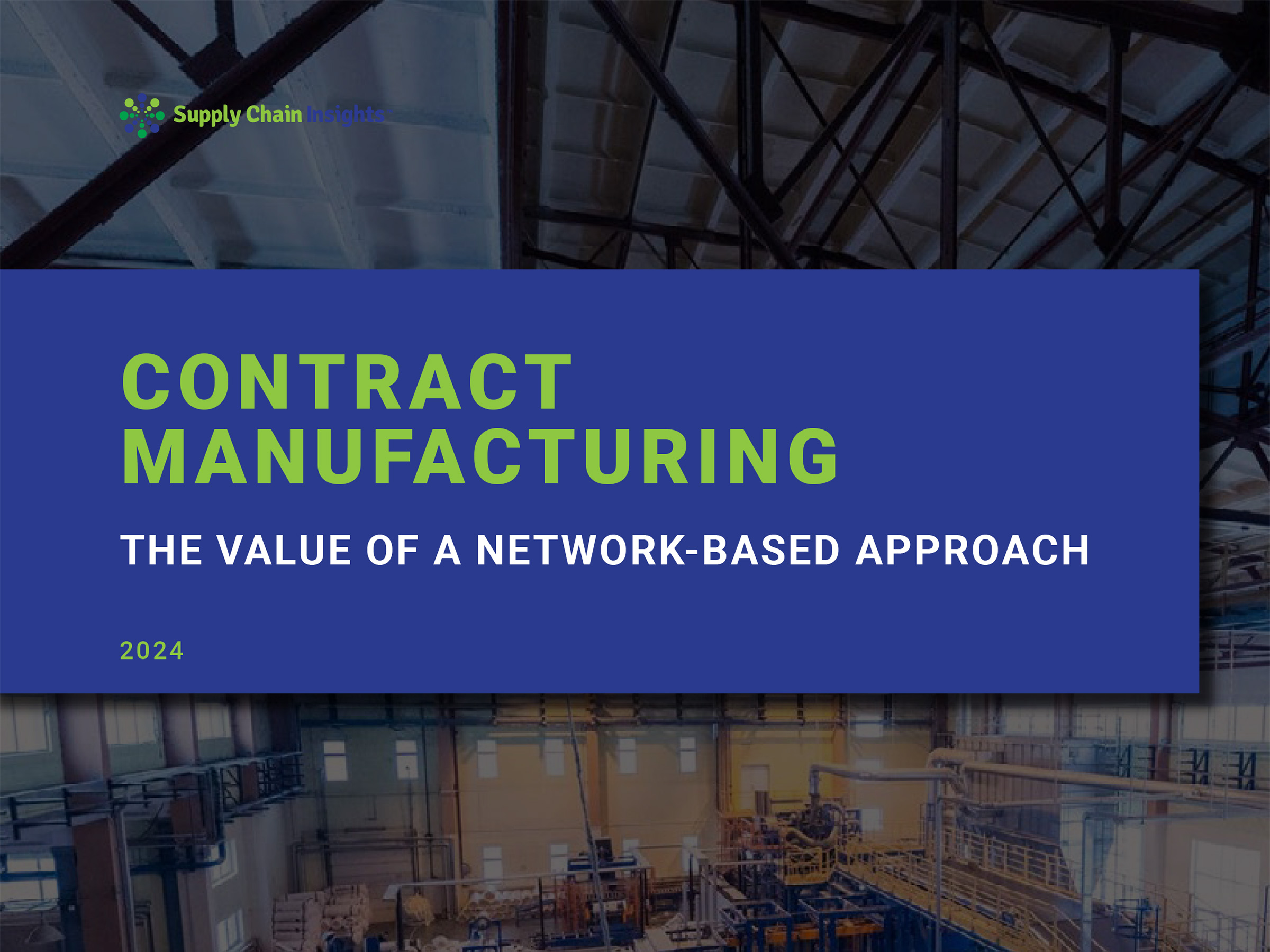
Cover of the 2024 Supply Chain Insights report Contract Manufacturing: The Value of a Network-Based Approach

The report, at a glance

32%
Average share of a brand owner's production made by contract manufacturers
81%
Of brand owners and contract manufacturers depend on email and spreadsheets
8%
Of flows between trading partners move through an automated network
85%
Faster access to data on the nine flows for brand owners with a network
Inside the Report

What the research recommends

Lora Cecere's recommendations for brand owners and contract manufacturers who want data to move at the speed of the business.

01

Use Your Channel Data

Most companies have channel data they don't use. Plan around channel flow and connect those insights to the network.

02

Reduce Data Latency

Automate bi-directional, multi-tier flows and wean the organization off spreadsheets and email. Map the black holes, then shrink them.

03

Plan for Supply Variability

Capture variability in inbound receipts, yields and run rates, and feed it into safety stock, procurement and production planning.

04

Invest in Multi-Tier Capabilities

Connect trading partners in meaningful ways. In network automation, the ERP architecture matters far less than interoperability.

05

Build the Talent

The people who built EDI networks are retiring. Form cross-functional teams that understand both the process and the data.

06

Use Standards

Make the most of GS1 and ISO 8000 standards, knowing they help but won't solve interoperability on their own.

Common Questions

Contract Manufacturing Report FAQ

1What does the report cover?

Survey and interview research on how brand owners, contract manufacturers and suppliers exchange nine data flows: quality control data, purchase orders, shipment status, materials on hand, perpetual inventory, manufacturing schedule changes, yields, available capacity and forecasts. It covers reasons for outsourcing, types of business networks, the cost of data latency, the bullwhip effect and recommendations.

2Who wrote the report?

Lora Cecere, Founder of Supply Chain Insights. The research panel was drawn from Supply Chain Insights followers, mostly at large North American brand owners, with follow-up qualitative interviews.

3What is a supply chain operating network?

A one-to-many or many-to-many network that shares data and processes between trading partners based on permissions, with onboarding, mapping and a system of record. The report contrasts it with one-to-one business networks, EDI value-added networks and marketplaces.

4How long does data take to arrive without a network?

In the research, shipment and quality information takes about 1.5 days, materials on hand and schedule changes about two days, and perpetual inventory signals about 2.5 days. The report calls these delays supply chain black holes.

5What is the bullwhip effect?

The way small changes in demand at the point of sale grow larger at each step upstream. The report's appendix shows how to measure it with the coefficient of variation at each decision node.

6How does Nulogy Supplier Collaboration connect brands with contract manufacturers?

Nulogy Supplier Collaboration gives brands real-time capacity, inventory and production status from every external partner, with every order using the same item and BOM data. Suppliers don't need to buy new software, and planners keep their existing planning tool.
See Nulogy Supplier Collaboration in Action

Talk to our team about connecting your contract manufacturers in real time.

  • Real-time capacity, inventory and production status
  • Same item and BOM data on every order
  • No new software for your suppliers
Book Your Demo